I Went to Statue of Unity
Almost about a month ago, I visited the Statue of Unity (SoU), Sardar Vallabhbhai Patel’s statue near Baroda. Hailed as the biggest statue in the world, this was my first experience of visiting a tourist destination in India after living and traveling in USA for over 3 years. Here are some of my thoughts and observations from that visit, in approximate order of my visit:
- I was there on 26th December, 2019. The tickets to go to the observation deck were sold out, so I could only walk up to the foot of the statue (more on that later).
- My first (and most consistent) observation throughout was the sheer mismanagement of the whole operation. The site had 3 attractions, the statue itself, a garden and a dam viewpoint. The only way to travel from one of the parking lots to these attractions was to take a bus setup and run by the SoU complex. However, I could not choose where I went. I was forced to go from parking - statue - dam - garden - statue - parking, getting off at each step, walk fairly significant distances, wait in long lines, before being able to get into the next bus. Talk about compounding delays…
- Every photo, hoarding, symbol in the SoU complex was attributed to Narendra Modi and (to a lesser extent) Vijay Rupani. I mean, just look at this bus run by SoU for transport in the area (not in the photo is a circular logo of Statue of Unity on the far left, of the same size as other circles). The photos of Modi and Rupani are, unsurprisingly, larger than the statue or Sardar Vallabhbhai Patel! Or look at the website for this statue, which maintains the same theme.
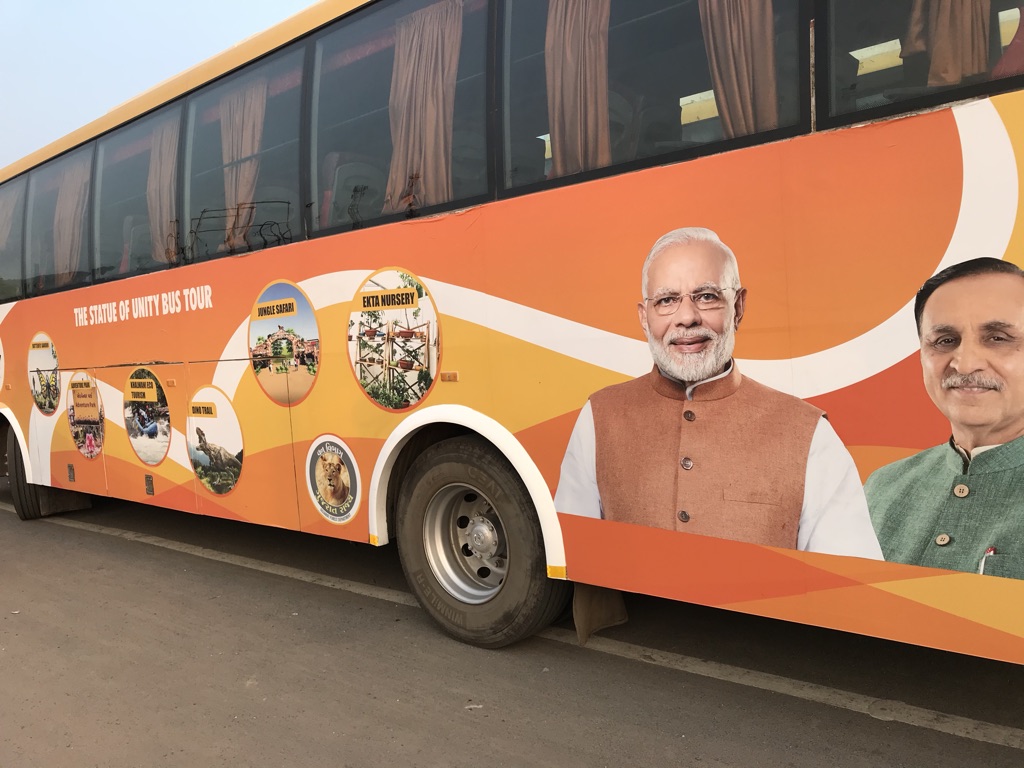
The transportation between different sights of attraction in the Statue of Unity complex.
- The dam was fine. It was a dam and there was nothing grand about it. Maybe I am colored by my visits to Hoover and Glen Canyon dams, but my dad agreed that there was nothing to see in the dam.
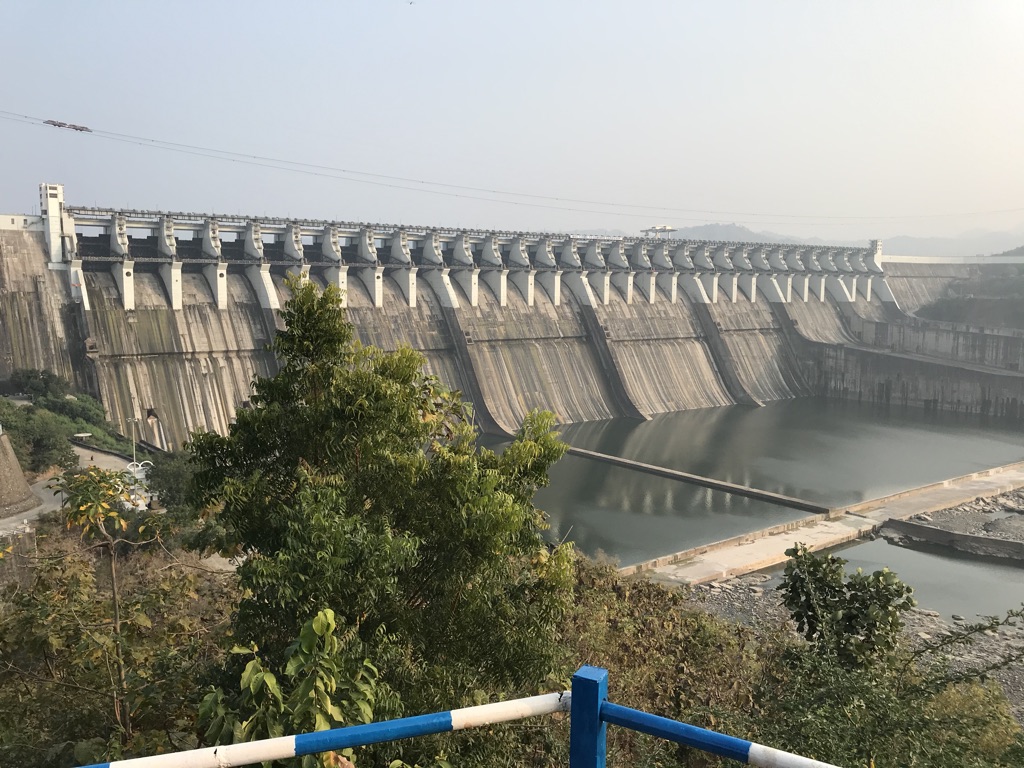
Sardar Sarovar Dam from the viewpoint near Statue of Unity.
- One thing that I found weird was that the focus was on the downstream of the dam. Every other dam I have visited focuses on showcasing the upstream and the reservoirs created by those dams. Personally, I feel like that has provided me a better perspective into the significance of the dam. Here, I thought the visit to the dam was absolutely pointless.
- The ‘Valley of Flowers’ was underwhelming. There were few flowers that you wouldn’t find in most places in India. The view of the statue, from here, however, was actually pretty neat.
- The statue was massive and pretty cool. However, at the end, it was just a statue and there was nothing more to it.
- The light and sound show, just after sunset, however, was exceptional. It was a great summary of the life and times of Sardar Vallabhbhai Patel. I learnt a little more about him and his work than I did before.
- The story of Patel and his work in the country, sadly, left out significant (but important) parts of history that matter. The story mentioned the troubles into getting the princely states of Junagadh and Hyderabad into the Dominion of India, but conveniently skipped any mention of Jammu and Kashmir, which Patel offered to Pakistan in exchange for Junagadh.
- Similarly, the whole show spoke of Jawaharlal Nehru exactly zero times. I felt that was inauthentic and inaccurate given how instrumental Nehru was in the integration of princely states into modern India.
- On the contrary, the show talked of Modi, his vision and his hard work a few too many times. The last 5 minutes of the show basically melted into a Narendra Modi cheerleading festival, including playing an audio of a speech Modi gave! I thought it was ridiculous that any politician, any CM, or any PM should be: a) accredited for building a statue, no matter how grand; and b) have his speech about him building the statue appear in a show meant to describe someone else’s life and work. It is narcissistic and egotistical.
- I realize that misinformation about Jammu and Kashmir and Jawaharlal Nehru serve the current dispensation, but I sincerely think distortion of history to appease a single party’s politics only furthers the divide in our country.
I am glad I went to Statue of Unity. I learnt a little more about Patel, but a lot more about my country.
What Narendra Modi Should Fix
A few days ago I posed a question to Twitter asking people what their tipping point for supporting Modi was? To put it in a different way, if you support Modi today (and / or have for the last 5+ years), what is the one thing, that if he does it, would make you cease supporting him.
It is not a very difficult question (but it can be). If you are someone that does support someone, anyone, something, I think this is a question you should ask yourself. I often ask the same of myself, and it helps me in understanding why I prefer something or someone over the other.
When it comes to Narendra Modi, though, while I was neutral about how I feel about him governing the country pre-2014, over time I have definitely grown to be more critical about his policies, style of politics and opposing what India has and is becoming, under his governance. I think he has made grave mistakes and strayed from the path of serving the country, while further dwelling in the arrogance of power.
So with this, I wanted to share a little bit more about what I would like to see done, which would make me feel more ambivalent about him.
- Stop systematically disseminating communal disharmony: Our Constitution enshrines and holds secularism as a founding principle. Be an embodiment of the principles encapsulated in the book you swore on. Unite the country, stop dividing it.
- Don’t treat the economy like sandbox: Accept the mistakes incurred in the past (demonetization, implementation of GST, ba../11.data-scienceSUs, etc.) and move towards fixing them. Mistakes in economic policy do not live in their own walled environments, they have far reaching effects on just every aspect of life in the country. Enough has been said about each aspect of the economy, and there are definite mitigation steps advised by many eminent economists.
- Put an end to systematic disinformation: One thing that is fundamental to me and my understanding of the world is data. The lack of reliable data from the government to independently verify its claims on a multitude of things, in every area, (be it GDP, jobs numbers, electrification, cleanliness efforts, etc.) is a problem. The lack thereof creates ripe ground for a vicious cycle of potential lies, that deepen the cracks in a society. This would work two-fold: 1) Leave no room for confusion, criticism or fake news, and 2) Add trust in the government.
That’s it. Not a long list, aye :)?
India & Politics
Indian politics is one of the most complicated and divided in the world, and it is amplified by the diversity of the country. I came across this forum discussion about why self-driving cars remain and will probably remain a dream in India for the foreseeable future, while the developed world inches towards policies and laws governing such vehicles. Much of the blame with a lot of India’s problems starts with the polity, but fairly trickle down to the people who put them in power.
“We get the politicians we deserve,” they say and I concur. Indian politicians have been obsessed with power and ruling, not working. And despite that, Indians have elected the same politicians. The fault does lie in our electoral thought process and the choices we make. Despite being a democracy, more often than not, Indians choose their local representatives based on their affiliations with a national outfit. This choice that does not account for representative’s local performance or policies is detrimental as it voids the importance of local issues. The PM will not fix the potholes in your lane; your local corporator, MLA, MP will. A politician who wants to work towards the progress of the constituency will also want to work with superiors at the city, state, country level and lead to progress of the country. But a representative who only wants to accumulate power will try to stay in power for the next 5 years by hook or crook.
A democratic entity functions successfully only when it works as a ground-up, and not top-down. There are some fundamental problems with the country and the only way to fix it is accountability. Our politicians need to be held accountable for every promise they make, every word they say and every policy they advocate for.
Ground realities change governments, not extravagant unfulfilled promises. Or so I hope.
P.S.: I wrote a similar, longer post when the 2014 Lok Sabha elections were approaching: The Dance Of Democracy.