I Went to Statue of Unity
Almost about a month ago, I visited the Statue of Unity (SoU), Sardar Vallabhbhai Patel’s statue near Baroda. Hailed as the biggest statue in the world, this was my first experience of visiting a tourist destination in India after living and traveling in USA for over 3 years. Here are some of my thoughts and observations from that visit, in approximate order of my visit:
- I was there on 26th December, 2019. The tickets to go to the observation deck were sold out, so I could only walk up to the foot of the statue (more on that later).
- My first (and most consistent) observation throughout was the sheer mismanagement of the whole operation. The site had 3 attractions, the statue itself, a garden and a dam viewpoint. The only way to travel from one of the parking lots to these attractions was to take a bus setup and run by the SoU complex. However, I could not choose where I went. I was forced to go from parking - statue - dam - garden - statue - parking, getting off at each step, walk fairly significant distances, wait in long lines, before being able to get into the next bus. Talk about compounding delays…
- Every photo, hoarding, symbol in the SoU complex was attributed to Narendra Modi and (to a lesser extent) Vijay Rupani. I mean, just look at this bus run by SoU for transport in the area (not in the photo is a circular logo of Statue of Unity on the far left, of the same size as other circles). The photos of Modi and Rupani are, unsurprisingly, larger than the statue or Sardar Vallabhbhai Patel! Or look at the website for this statue, which maintains the same theme.
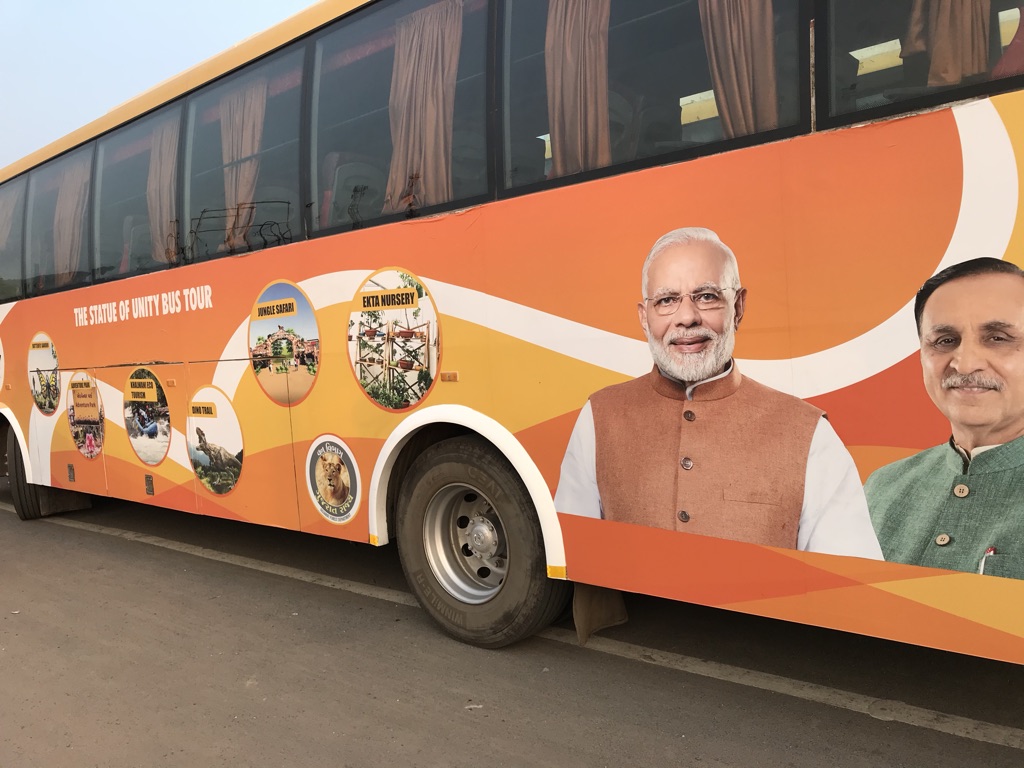
The transportation between different sights of attraction in the Statue of Unity complex.
- The dam was fine. It was a dam and there was nothing grand about it. Maybe I am colored by my visits to Hoover and Glen Canyon dams, but my dad agreed that there was nothing to see in the dam.
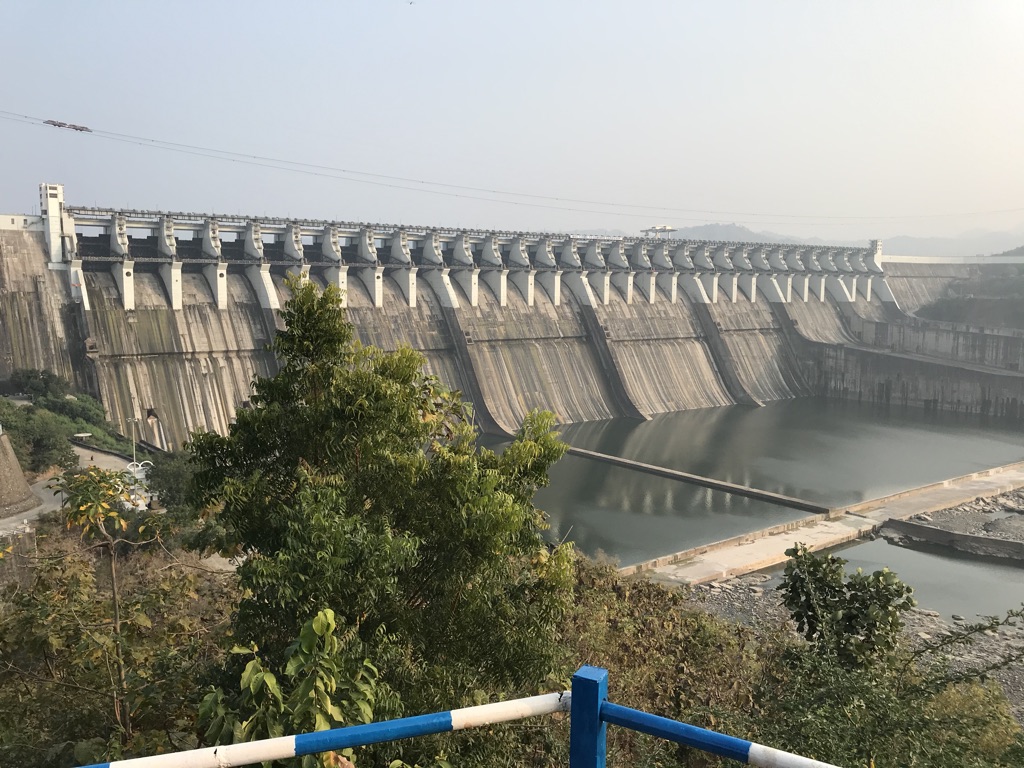
Sardar Sarovar Dam from the viewpoint near Statue of Unity.
- One thing that I found weird was that the focus was on the downstream of the dam. Every other dam I have visited focuses on showcasing the upstream and the reservoirs created by those dams. Personally, I feel like that has provided me a better perspective into the significance of the dam. Here, I thought the visit to the dam was absolutely pointless.
- The ‘Valley of Flowers’ was underwhelming. There were few flowers that you wouldn’t find in most places in India. The view of the statue, from here, however, was actually pretty neat.
- The statue was massive and pretty cool. However, at the end, it was just a statue and there was nothing more to it.
- The light and sound show, just after sunset, however, was exceptional. It was a great summary of the life and times of Sardar Vallabhbhai Patel. I learnt a little more about him and his work than I did before.
- The story of Patel and his work in the country, sadly, left out significant (but important) parts of history that matter. The story mentioned the troubles into getting the princely states of Junagadh and Hyderabad into the Dominion of India, but conveniently skipped any mention of Jammu and Kashmir, which Patel offered to Pakistan in exchange for Junagadh.
- Similarly, the whole show spoke of Jawaharlal Nehru exactly zero times. I felt that was inauthentic and inaccurate given how instrumental Nehru was in the integration of princely states into modern India.
- On the contrary, the show talked of Modi, his vision and his hard work a few too many times. The last 5 minutes of the show basically melted into a Narendra Modi cheerleading festival, including playing an audio of a speech Modi gave! I thought it was ridiculous that any politician, any CM, or any PM should be: a) accredited for building a statue, no matter how grand; and b) have his speech about him building the statue appear in a show meant to describe someone else’s life and work. It is narcissistic and egotistical.
- I realize that misinformation about Jammu and Kashmir and Jawaharlal Nehru serve the current dispensation, but I sincerely think distortion of history to appease a single party’s politics only furthers the divide in our country.
I am glad I went to Statue of Unity. I learnt a little more about Patel, but a lot more about my country.
Sapiens by Yuval Noah Harari
Over the years, one thing that consistently bothered me was my inability to read and finish books. I started a lot of books, but finished rarely any. Over time, I lost interest in reading books. I read a lot of articles, blogs and news stories, some tens of thousands of words long, but I never got around to reading books.
In late November, I decided that I wanted to change this about myself and that I wanted to read more. For that, I needed a book that would keep me hooked, keep me interested. Over the last year, I had read and heard a lot of praise for Sapiens, and I was certain that that was the book I wanted to read. And so, it was.
I just finished reading the book last night, and to say it was an eye-opener, is an under-statement. It is an astute account of the rise of homo sapiens, the various revolutions that have occurred over the last several millenia, and goes on to lucidly describe the dominant (and other theories) surrouding each one of them.
One of its primary gifts to me was a new perspective. I had accepted humanity as it exists today (capitalism, social structure, religions, agricultural practices, etc.) without sufficiently understanding how they came to be. I now understand a little more about the story of the homo sapiens than I ever did.
Harari helped me learn more by questioning the why, which I hadn’t earlier, out of my arrogance, ignorance or both.
One of the most profound quotes of the book appears in the ‘Afterword’ and summarises everything the book goes over ever so succintly:
Seventy thousand years ago, homo sapiens was still an insignificant animal minding its own business in a corner of Africa. In the following millenia it transformed itself into the master of the entire planet and the terror of the ecosystem. Today it stands on the verge of becoming a god, poised to acquire not only eternal youth, but also the divine abilities of creation and destruction.
Here’s to the next book, and then a few more .
Merriam-Webster Word of the Year 2019: They
There were a few things towards the end of 2019 that made me happy. ‘They’ being chosen as word of the year, was one among them.
Over the last year, I have started using ‘they’ frequently as pronouns for people whose pronouns I did not know, and it started from something really simple: I choose to not give pronouns to someone else. I want to let them be them, pick their pronouns, respect their identity, and not judge them.
I’m not perfect, and I’m still learning. But I’m extremely glad that in 2019, my word of the year was the same .