Online Privacy Should Be Modeled on Real-World Privacy
I read Daring Fireball often and one of the things I strongly agree with Gruber on is privacy. I think privacy ought to be a fundamental right and I loathe the practices of tech companies that are formulated on invading it. That is also why I use DuckDuckGo as my default search engine.
John Gruber wrote this post following Apple’s new iPhone ad (watch it, it is a great one) about companies act as privacy thieves by tracking people across the internet. I agree with it in its entirety.
They have zero right, none, to the tracking they’ve been getting away with. We, as a society, have implicitly accepted it because we never really noticed it. You, the user, have no way of seeing it happen. Our brains are naturally attuned to detect and viscerally reject, with outrage and alarm, real-world intrusions into our privacy. Real-world marketers could never get away with tracking us like online marketers do.
We definitely wouldn’t accept this type of behavior in the real world!
The tracking industry is correct that iOS 14 users are going to overwhelmingly deny permission to track them. That’s not because Apple’s permission dialog is unnecessarily scaring them — it’s because Apple’s permission dialog is accurately explaining what is going on in plain language, and it is repulsive. Apple’s tracking permission dialog is something no sane person would agree to because this sort of tracking is something no sane person would agree to.
Yes.
The privacy thieves have, unsurprisingly, come out against these expected changes coming in iOS 14, and tried to defend their entitlement. They should have none. And they would have none if their business models were based on asking users for permission (as Apple’s system is expected to).
More privacy for one and all.
Good Sudoku
I’m a sucker for sudoku. I was obsessed about 7-8 years ago and solved it every single day for a while (thanks, Mumbai Mirror!).
In the week after I watched and posted about the Miracle Sudoku, Zach Gage and Jack Schlesinger released a great sudoku game. I have been obsessed and can’t stop playing.
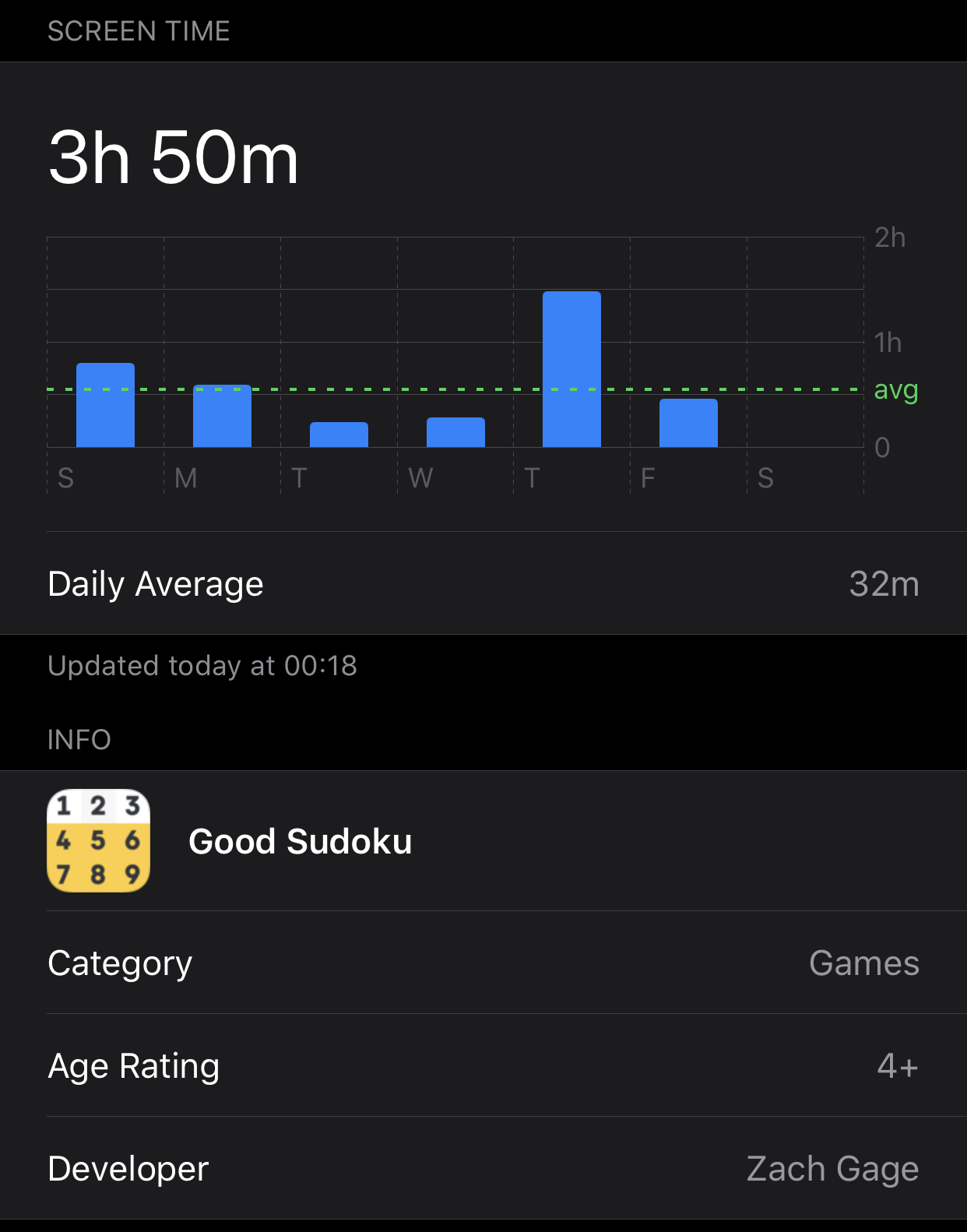
My total daily phone screen time is ~2.5 hours and >20% on average has been playing Good Sudoku for the last few weeks. That’s how much I love it.
Go, have some fun and play it. (Also, send help. I really need to limit how much time I spend playing it…)
How the pandemic might play out in 2021 and beyond
One thing that has constantly been on my mind for the last 7+ months: The COVID-19 pandemic 1. There’s so much I have read about it, heard about it, tried to learn about it, but a thought exercise around long-term implications of it fascinated me early on.
Thereafter, I spent a weekend looking at the how walking and driving habits had changed in various Indian cities.
More recently, as discussions around vaccines progress, and we learn more about SARS-CoV-2 and how it attacks the human body, I have also been thinking about what we can expect in the medium- to long-term as governments succeed or fail in controlling the spread of the pandemic.
The rest of 2020 will almost certainly continue more or less the same way as it has for the last 7 months, but what might the world look like in 2021?
Megan Scudellari for Nature, in “How the pandemic might play out in 2021 and beyond”, provides an important view into what epidemiologists are thinking:
Around the world, epidemiologists are constructing short- and long-term projections as a way to prepare for, and potentially mitigate, the spread and impact of SARS-CoV-2, the virus that causes COVID-19. Although their forecasts and timelines vary, modellers agree on two things: COVID-19 is here to stay, and the future depends on a lot of unknowns, including whether people develop lasting immunity to the virus, whether seasonality affects its spread, and — perhaps most importantly — the choices made by governments and individuals.
But also, don’t stop washing hands or wearing masks. It helps:
But there is hopeful news as lockdowns ease. Early evidence suggests that personal behavioural changes, such as hand-washing and wearing masks, are persisting beyond strict lockdown, helping to stem the tide of infections. […] The team concluded that if 50–65% of people are cautious in public, then stepping down social-distancing measures every 80 days could help to prevent further infection peaks over the next two years4. “We’re going to need to change the culture of how we interact with other people,” says Neto. Overall, it’s good news that even without testing or a vaccine, behaviours can make a significant difference in disease transmission, he adds.
So, what really happens in 2021 and beyond? We don’t know. Not yet:
The pandemic’s course next year will depend greatly on the arrival of a vaccine, and on how long the immune system stays protective after vaccination or recovery from infection. Many vaccines provide protection for decades — such as those against measles or polio — whereas others, including whooping cough and influenza, wear off over time. Likewise, some viral infections prompt lasting immunity, others a more transient response. “The total incidence of SARS-CoV-2 through 2025 will depend crucially on this duration of immunity,” wrote Grad, Harvard epidemiologist Marc Lipsitch and colleagues in a May paper14 exploring possible scenarios (see ‘What happens next?’).
That’s a somber reality.
Early on, I kept up with COVID-19 stats using John Hopkins’ tracker. Thereafter, I found this incredibly simple2 but informative tracker and haven’t looked back. ↩︎
There’s a brilliant profile of the teen that built the tracker I’ve been using for the last few months on MIT Technology Review. ↩︎
The United Nations of Uniqlo
Over the last 18 months, Uniqlo has gone from being a brand I had no idea existed to my preffered clothing brand. The simplicity of the designs and the great quality of the clothes have won me over. Be it solids, polos or graphic tees.
So when The Economist had a profile piece about Uniqlo by Amelia Lester, you bet I read it.
Some quotes that are telling of the story of the company, its success and its goals:
Uniqlo’s parent firm, Fast Retailing, is now the world’s third-largest clothing company, after Inditex (which owns Zara) and h&m. Today the ubiquity and predictability of Uniqlo’s products are part of the brand’s identity, an essential component of Yanai’s aspiration to become “the first truly global clothing brand from Asia”.
On the clothes:
Unusually for a clothing company, Uniqlo measures its significant milestones not in iconic outfits but in manufacturing breakthroughs. After its success with the fleece, Uniqlo rolled out more product lines that were distinguished by their functionality: a first-of-its-kind bra top with sewn-in cups, thermal underwear, moisture-wicking fabric and lightweight puffer coats filled with down.
What differentiates it from its competitors:
Unlike competitors that often feature aspirational pictures of models in perfectly fitting garb, Uniqlo stores use rotating putty-coloured mannequins (“a neutral colour that is not white”, a PR officer tells me).
I agree:
Uniqlo’s plainness and restraint appeals to consumers across the globe. These design principles also help the company negotiate the tension between the low cost of its garments and the perception of good quality.
On the shopping experience:
The retail experience seemed very Japanese: the shop was crowded, though not disorganised. The long queue to pay moved swiftly, with an efficiency not often encountered in suburban America. After I made my purchase, my credit card was handed back to me with two hands, as is customary with all interactions involving money in Japan.
The Miracle Sudoku
Trust me and take 25 minutes out to watch this. Just trust me.
Playing with Apple's COVID-19 Mobility Data for India
I came across Apple’s COVID-19 mobility dataset in mid-May. Instantly, I was curious. I have been interested in understanding how the world is changing ever since the pandemic begam, and thinking about what it means in the short and long-term.
As I started exploring the data and seeing some interesting patterns in there, I started thinking about if there were ways I could share it and make it public. Of course, there’s always Jupyter Notebooks, but I don’t enjoy making my notebooks overtly formal and presentable.
Around that time, I remembered streamlit (a UI framework for converting simple Python apps into websites) as something I had wanted to try for a few months. Next question: How do I host it? Well, I had heard and read about Heroku1 being a simple and fast way to deploy websites and web apps.
Lo and behold, it all came together over a weekend into something I like. I just updated it today with more recent data and some additional notes.
I host my website using Netlify, which is great for static-sites. There is probably a way to get streamlit to output a static site, but I went with the easiest path to get it out there. ↩︎
For All Mankind
Among the first set of Apple TV+ shows, ‘For All Mankind’ excited me more than others. Over the last few days, I have watched some of the released episodes and I’m really impressed by it. I think it is a compelling story-line.
The plot of the show is fairly simple: What if Russians landed a human on the moon before the USA? How would the space race unfold after that event? How swiftly would space progress unfold thereafter?
Having throughly enjoyed another alt-reality show (I’m looking at you, ‘The Man in the High Castle’), ‘For All Mankind’ was supposed to be right up my alley, and I haven’t been disappointed .
The Seen and The Unseen
I have been listening to podcasts for a few years now. Most of the podcasts I listen to are (unsurprisingly) tech-related. However, slowly, my podcast feed has been growing for the last year or so, with new feeds that focus on politics, economics and current affairs. As my schedule gets more streamlined, I listen to more podcast episodes every week. It makes a lot of sense to listen to them while I’m doing chores or while I’m commuting. (If you use iOS and listen to podcasts, go, try Overcast if you don’t know about it already. It is the best podcast player out there.)
One of the podcasts that I have been most looking forward to lately, has been ‘The Seen and The Unseen’ hosted by Amit Varma. The show is set at the intersection of politics, social science and economics, in the Indian context. The guests focus on statistical evidence, facts and historical significance, and how they lend voice to their opinions. With every episode, I learn new things, understand old topics better, and am usually riveted throughout the episode.
Some noteworthy episodes that I have heard recently:
- Episode 116: India’s Lost Decade: A discussion about financial mismanagement during 2009-2019 that has left India’s economy in such a slow growth period.
- Episode 115: The Intellectual Foundations of Hindutva: A trace of the roots, growth and rise of RSS and the Hindutva ideology, from someone who once was a believer.
- Episode 119: Modi’s Lost Opportunity: One of the lesser-known (to me) spokespeople from Congress, Salman Soz, talks about the good, bad and ugly during 2014-2019. Extremely fair and unbiased. His take on dynasty politics was particularly realistic.
I highly recommend everyone who enjoys a smart conversation on important, controversial, difficult subjects to listen to it. Even if you don’t agree to it, it will make you rethink and re-assert your opinions, with more information at your disposal.